
Insights · 30 September 2026
International Translation Day 2026: How Technology Is Breaking Language Barriers
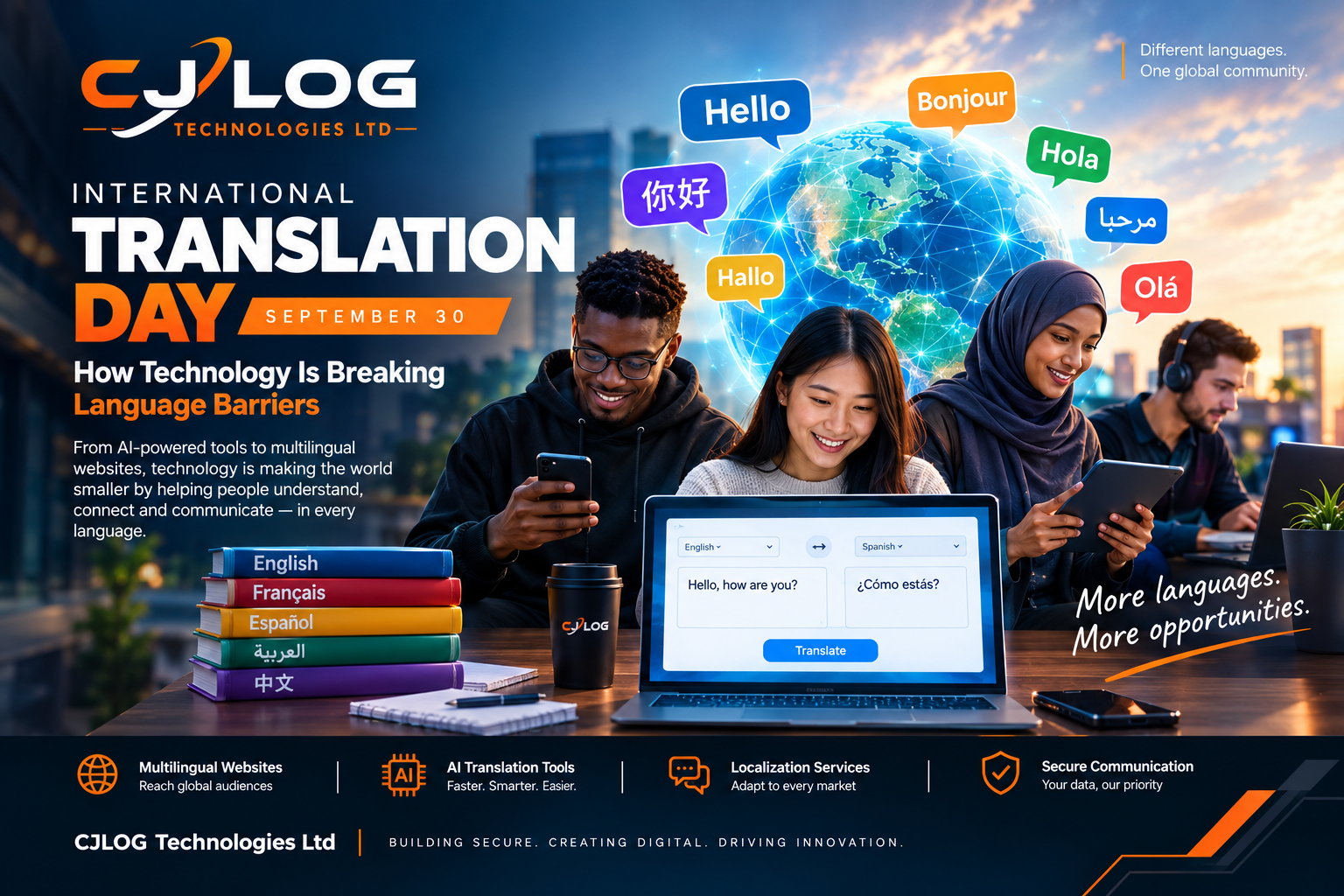
Connecting People Beyond Language
Every year on September 30, the world observes International Translation Day, recognising the important role translation and language professionals play in connecting people, cultures, businesses, and communities.
In a world where communication increasingly happens across borders, the ability to understand and share information in different languages has become more important than ever.
Technology is playing a major role in this transformation.
From artificial intelligence and machine translation to multilingual websites and communication platforms, digital tools are making it easier for people to communicate across language barriers.
At CJLOG Technologies Ltd, we believe technology should help people connect, communicate, and access opportunities regardless of where they are or what language they speak.
Technology Is Changing Translation
Translation has traditionally required human expertise to convert information from one language into another while preserving its meaning and context.
Today, technology can assist with many parts of this process.
Artificial intelligence and machine-learning systems can analyse large amounts of language data and generate translations within seconds. Translation tools can help users understand websites, documents, messages, and conversations in languages they may not speak.
This has made translation faster and more accessible.
However, technology does not eliminate the importance of human understanding.
Language is more than words.
It includes culture, context, tone, expressions, humour, and meaning.
For important communication, human review and expertise can still be essential.
AI and the Future of Translation
Artificial intelligence is becoming an increasingly important part of language technology.
Modern AI systems can assist with:
Translating text between languages
Summarising information
Converting speech into text
Translating conversations
Generating subtitles
Localising websites and applications
Supporting multilingual customer service
Helping developers build language-aware applications
These capabilities can help businesses and organisations communicate with audiences around the world.
For example, a company can develop a website that provides information in multiple languages, allowing more customers to understand its services and interact with the organisation.
Multilingual Websites and Digital Services
For businesses operating in international or culturally diverse markets, language accessibility can be an important part of digital strategy.
A multilingual website can help organisations communicate their services to different audiences while creating a more inclusive user experience.
Software applications can also be designed to support multiple languages.
This requires more than simply translating a few words on a screen.
Good localisation considers:
Language and terminology
Date and time formats
Currency
Cultural expectations
User interface layout
Accessibility
Local regulations
Search behaviour
Technology makes these possibilities increasingly practical for businesses of different sizes.
Breaking Language Barriers in Africa
Africa is home to thousands of languages, creating both a remarkable cultural diversity and a significant opportunity for language technology.
Digital platforms that support more languages can potentially make education, business information, government services, and online resources accessible to wider audiences.
In Nigeria, for example, English is widely used in formal communication, but many people also communicate in indigenous languages such as Yoruba, Hausa, and Igbo, alongside numerous other languages.
Developing technology that recognises and supports linguistic diversity can help create more inclusive digital experiences.
Translation and Access to Information
Language can sometimes become a barrier to accessing important information.
Technology can help reduce that barrier by making information available in languages that people understand.
This can be particularly valuable in areas such as:
Education — allowing students to access learning resources across languages.
Business — helping organisations communicate with customers and partners in different markets.
Healthcare — supporting communication and access to information, while recognising that critical medical translation requires appropriate professional oversight.
Technology — making software and digital services accessible to a wider audience.
Communication — helping people interact across geographical and linguistic boundaries.
The Importance of Accuracy and Privacy
While translation technology provides significant opportunities, it also requires responsible use.
Automated translation can sometimes misunderstand context, terminology, cultural references, or specialised language.
For sensitive or high-stakes information, professional translation and human review may be necessary.
Privacy is also important.
Users should be careful when submitting confidential documents, personal information, business data, or other sensitive material to online translation services.
Technology should make communication easier without compromising people's privacy and security.
Technology That Connects People
At CJLOG Technologies Ltd, we believe technology is most valuable when it solves real problems.
Our work across software development, website design and development, cybersecurity, graphic design and branding, and IT consultancy reflects our focus on creating practical digital solutions.
Language technology represents another example of how innovation can improve the way people interact with digital systems.
Whether it is a multilingual website, a customer-support platform, an AI-powered application, or software designed for international users, technology can help organisations communicate more effectively.
Looking Ahead
The future of translation will likely involve an increasingly close relationship between human expertise and artificial intelligence.
AI can provide speed and scale.
Human professionals provide context, cultural understanding, judgement, and quality control.
Together, they can help create better ways for people to communicate across languages.
The goal should not simply be to translate more words.
It should be to understand more people.
Our Message on International Translation Day
Language is one of the things that makes every culture unique.
Technology gives us an opportunity to celebrate that diversity while creating new ways for people to understand one another.
On this International Translation Day 2026, CJLOG Technologies Ltd celebrates translators, interpreters, linguists, developers, researchers, and innovators working to make communication more accessible.
Language may separate words, but technology can help connect people.
CJLOG Technologies Ltd
Building Secure. Creating Digital. Driving Innovation.
Comments (0)